

Table of Contents
- What Makes a Craft Kit Worth Buying for Adults
- Beginner-Friendly Needlework Kits: What to Look For
- How to Choose a Craft Kit for Your Skill Level and Schedule
- Essential Tools for DIY Craft Kits: What Should Be in the Box
- Craft Kits for Adults: Popular Types and Who They Suit
- Common Mistakes When Buying Craft Kits (and How to Avoid Them)
- Frequently Asked Questions
Last Updated: September 13, 2026
What Makes a Craft Kit Worth Buying for Adults
The best craft kits for adults are worth buying when they remove the two biggest barriers to finishing a project: missing materials and unclear instructions. This guide from Stitch Kit Shop breaks down exactly what separates a kit you'll complete from one that joins the unfinished pile.
The best craft kits for adults share three traits: a complete materials list, instructions written for the skill level stated on the box, and a project you actually want to display when it's done. Everything else is packaging.
Here's the honest part most buying guides skip. A kit's real value isn't the sum of its contents, it's whether the contents match the project's demands. A cross-stitch kit with beautiful thread but a low-resolution chart will frustrate a beginner within an hour (craftscouncil.org.uk). A knitting kit with premium yarn but no stitch glossary leaves a first-timer stuck on row three.
So before you compare designs, compare completeness. Check whether the listing states the finished size, the skill level, and the exact tools included. If a seller won't tell you what's in the box, that's your answer.
Beginner-Friendly Needlework Kits: What to Look For
Beginner-friendly needlework kits should prioritise guided instruction over ambitious design. A simple pattern with a clear stitch-by-stitch guide teaches more than an intricate one that assumes prior knowledge.
When you're new to needlework, the pattern itself matters less than the support around it. Look for these markers:
- Printed patterns with symbols explained on a separate key
- Pre-sorted threads or pre-cut fabric, so you're not measuring before you're stitching
- A stitch glossary with diagrams, not just names
- A finished-size reference so you know what you're aiming for
- Access to video or photo tutorials for the trickier stitches
The single most common beginner mistake is choosing a kit by how the finished piece looks rather than by how it's taught. A beautiful design with thin instructions will sit unfinished. A modest design with thorough guidance gets completed, and completing it is what builds the confidence to try the next one.
If you're unsure whether a kit suits a true beginner, check whether the seller labels skill levels explicitly. Vague terms like "suitable for all" often mean "written for people who already craft."
How to Choose a Craft Kit for Your Skill Level and Schedule
Match the kit to your realistic weekly crafting time, not your ideal one. A project that needs six focused hours will stall if you only have forty minutes on a Sunday evening.
Start by being honest about two things: your current skill level and your actual free time. Then use this framework:
| Your Situation | Best Kit Type | What to Check |
|---|---|---|
| Complete beginner, under 2 hrs/week | Small counted cross-stitch or simple embroidery | Pre-sorted threads, large-print chart |
| Some experience, 2-5 hrs/week | Intermediate embroidery or beginner knitting | Stitch glossary, yarn quantity stated |
| Confident crafter, 5+ hrs/week | Larger tapestry or multi-part fibre art | Full material list, finishing instructions |
| Time-poor but experienced | Single-session projects | Compact design, minimal setup |
A common mistake is overestimating your schedule (pubmed.ncbi.nlm.nih.gov). Many people buy a large kit in January and abandon it by March because the project size never matched their calendar. Smaller, finishable projects build momentum; oversized ones build guilt.
If you're returning to a craft after years away, treat yourself as a beginner for the first project. Skills fade, and a refresher kit costs far less than a stalled ambitious one.
Essential Tools for DIY Craft Kits: What Should Be in the Box
Essential tools for DIY craft kits vary by discipline, but a genuinely complete kit includes everything needed to finish the project without a separate shopping trip. If you have to buy a hoop, a needle, or a skein of thread before you can start, the kit isn't complete.
For needlework specifically, a well-assembled kit typically contains:
- The correct needle type and size for the fabric
- Fabric cut to size, with a margin for framing or finishing
- All threads in the quantities the pattern requires
- A printed pattern plus a symbol key
- An embroidery hoop or frame where the design calls for one
- Finishing instructions for turning the work into a displayable piece
What most guides miss is the finishing step. Plenty of kits get you to the last stitch and then stop, leaving you with a completed design and no idea how to frame, mount, or hang it. A kit that explains finishing is worth more than one with fancier thread.
Craft Kits for Adults: Popular Types and Who They Suit
Craft kits for adults fall into a handful of broad categories, and each suits a different temperament. The right choice depends less on the craft itself than on how you like to work.
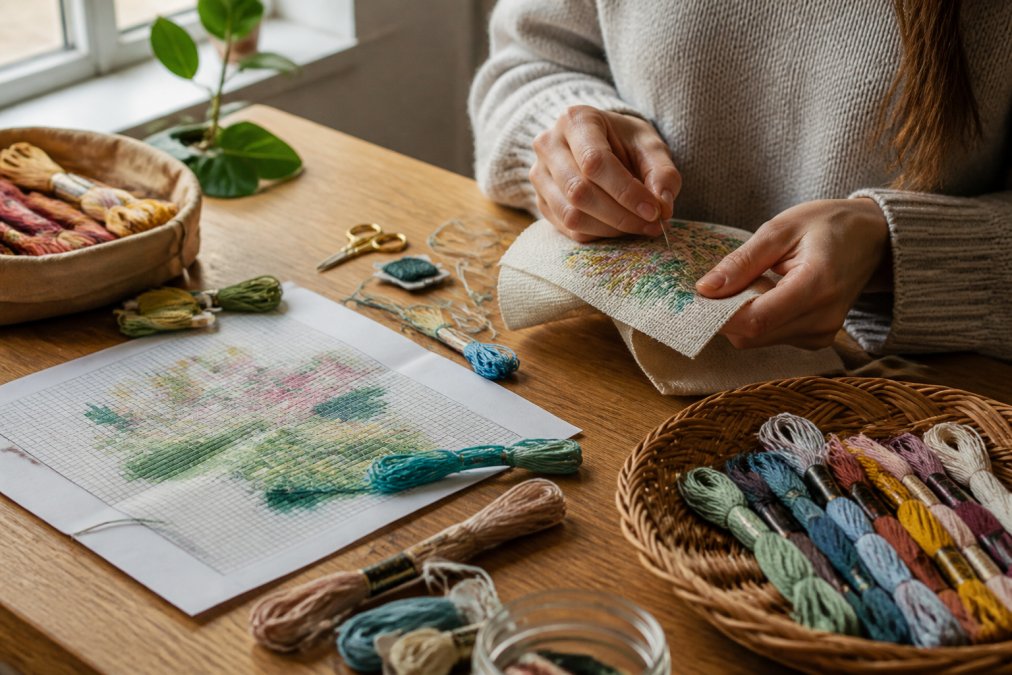
Counted cross-stitch suits people who enjoy precision and quiet repetition. It's grid-based, forgiving of pauses, and easy to pick up and put down.
Embroidery appeals to those who want more freehand expression. It rewards patience and offers more variation in stitch and texture.
Knitting and crochet kits work well for crafters who want a wearable or usable result. They take longer to learn but produce items you'll actually use.
Tapestry and needlepoint suit anyone who wants a substantial, meditative project with a clear end point.
Mixed fibre art kits attract experienced crafters who want to combine techniques and don't mind improvisation.
If you're crafting to unwind after long working days, cross-stitch and embroidery tend to fit better than knitting, simply because they're easier to leave and resume without losing your place (the NHS).
Common Mistakes When Buying Craft Kits (and How to Avoid Them)
The most common mistake when buying craft kits is choosing by finished appearance alone. A design you love but can't execute becomes clutter; a design that matches your level becomes a finished object you're proud of.
Other pitfalls worth avoiding:
- Ignoring the skill level. If a kit doesn't state one, assume it's aimed at crafters with some experience.
- Buying materials separately "to save money." By the time you've sourced fabric, threads, needles, and a pattern, the savings often vanish, and you've spent an afternoon on it.
- Overlooking delivery and packaging. Loose threads and crushed boxes turn a relaxing hobby into a returns process.
- Skipping the instructions preview. Many sellers show a sample page. If the instructions look thin in the preview, they're thin in the box.
- Forgetting the finishing plan. Decide where the finished piece will live before you start it.
A useful habit is to keep one project in progress at a time. Crafters who rotate five unfinished kits rarely finish any of them, and the half-done pile becomes a source of stress rather than calm.
Finding a kit that fits your skill level, your schedule, and your taste takes more searching than it should. Stitch Kit Shop was built to close that gap: our needlework and fibre art kits are created by Kirsty and Rachel, with all-in-one materials, clear guided instructions, and a 4.69-star rating from 54 reviews. Personalised subscription boxes match kits to your crafting style, and worldwide delivery brings them to your door. Browse the collection and start your next project with everything you need in one box.
Frequently Asked Questions
What are the best craft kits for beginners?
For absolute beginners, look for kits labelled as beginner-friendly needlework kits. These typically include pre-printed patterns, larger needles, and step-by-step photo instructions. Kits with a single technique, such as cross stitch or simple embroidery, are easier to finish than multi-craft kits. Check that the kit lists all included materials and recommends a realistic completion time. Stitch Kit Shop offers a range of starter kits designed for those new to needlework, with clear guidance and support.
Are craft kits worth the money?
Craft kits can be good value if you factor in the time saved sourcing individual materials and the guidance provided. A kit bundles everything you need, so you avoid buying full skeins or packs of needles you may never use again. The quality of instructions and materials also affects whether you finish the project. If a kit helps you complete a satisfying project and learn a skill, the cost per hour of enjoyment is often lower than many other leisure activities. Compare what is included rather than just the headline price.
How do I choose the right craft kit for my skill level?
Start by identifying your experience with the specific craft. If you are new to needlework, choose a kit marked beginner or easy, which usually means larger stitches, simpler patterns, and fewer colour changes. Intermediate kits assume you can follow a chart and handle basic stitches. Advanced kits often involve fine threads, complex shading, or specialty techniques. Also consider your available time: a small project with a clear finish line is better for busy schedules than a large one that takes months.
Do craft kits include all the necessary tools?
Most comprehensive craft kits include the essential tools for DIY craft kits, such as needles, thread, fabric, and instructions. However, some kits may require basic items you already own, like scissors or an embroidery hoop. Always read the product description to see what is included and what is not. If a kit lacks a key tool, factor in the extra cost. Stitch Kit Shop kits are designed to be all-in-one where possible, so you can start crafting straight away.